The advent of large language models like ChatGPT, Claude, and similar AI systems has democratized access to translation capabilities. Anyone can now upload a PDF document and receive a translation in seconds, seemingly eliminating the need for professional translation services. However, beneath the surface convenience lies a fundamental problem that becomes apparent when organizations attempt to use AI-generated translations professionally: profound inconsistency across iterations. Translate the same document twice, and you'll receive two different translations with varying terminology, shifting tone, and restructured sentences—inconsistencies that create serious problems for professional content.
The Stateless Nature of AI Translation
Understanding why AI-generated translations vary across iterations requires grasping a fundamental characteristic of large language models: they are stateless and probabilistic. Each time you request a translation, the AI generates it from scratch without reference to previous translations of the same content. Unlike human translators who might refer to their earlier work or translation memories that store previous decisions, AI models treat each translation as a completely new task.
The probabilistic nature compounds this issue. These models don't have a single "correct" translation stored internally. Instead, they generate translations by predicting likely word sequences based on training data and context. This prediction process involves randomness—temperature settings and sampling strategies introduce variability even when translating identical source text. What seems like a minor technical detail has profound practical implications.
When you translate a ten-page PDF through ChatGPT on Monday and then translate the same PDF again on Wednesday, you'll receive two versions with hundreds of micro-differences. A technical term translated as "interface" in the first version might become "user interface" or "interface panel" in the second. A formal tone in one iteration might shift slightly more casual in another. These variations might seem trivial in isolation but accumulate into serious consistency problems across larger documents and translation projects.
Terminology Inconsistency: The Most Critical Problem
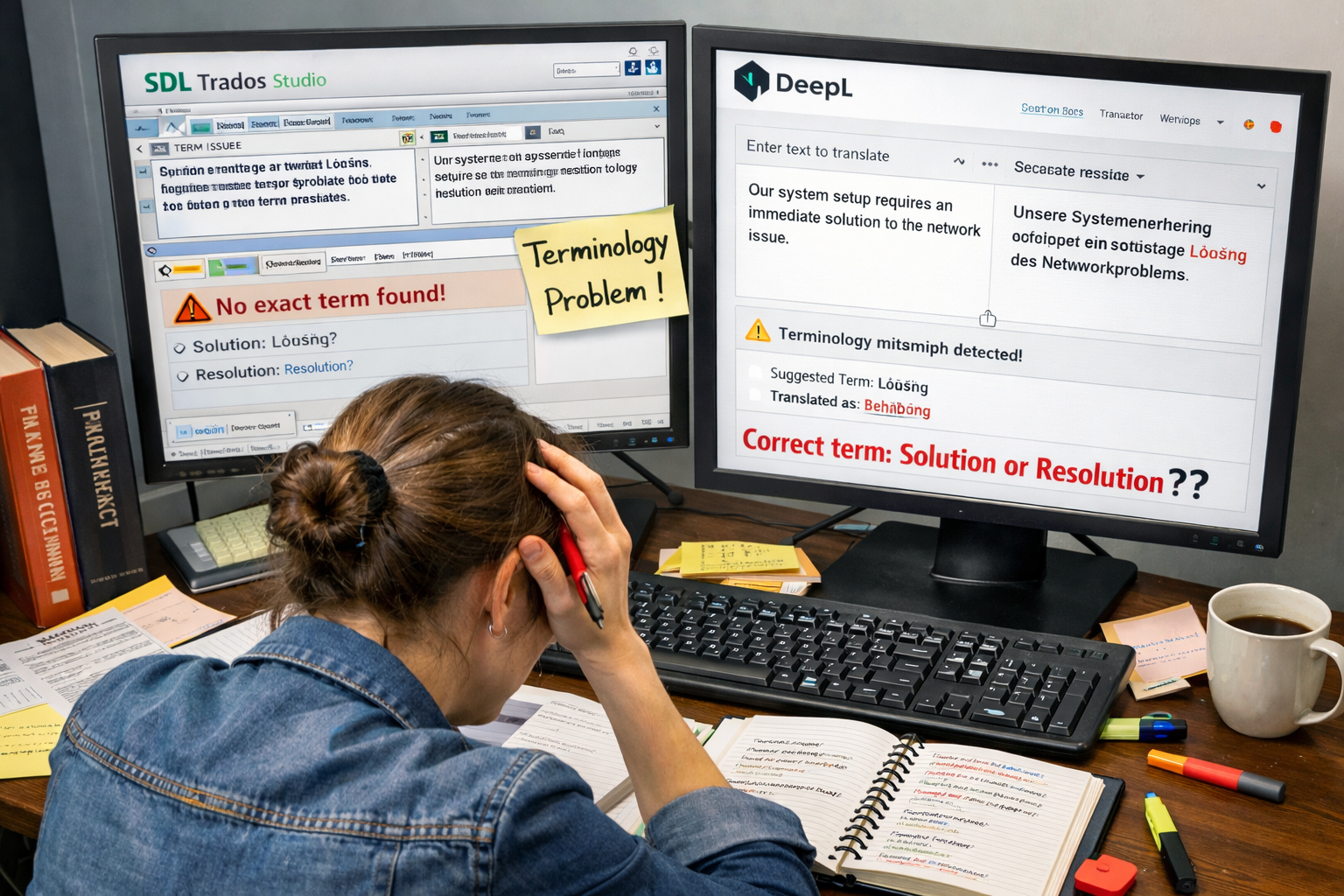
Terminology consistency represents perhaps the most damaging weakness of AI-generated translations. Professional translation requires that specific terms—product names, technical concepts, industry jargon—translate identically throughout all content. A "database management system" cannot become a "database administration system" halfway through a document or across different documents in the same product line.
AI models lack the systematic terminology management that professional translation workflows employ. They don't maintain termbases or glossaries that enforce consistent term translations. Instead, they translate each occurrence of a term based on immediate context, often producing different translations for the same source term depending on surrounding sentences.
This problem intensifies when translating technical or specialized content. Consider a software manual that mentions "user authentication" fifty times. An AI translation might render this as "user authentication" in some instances, "user verification" in others, "identity confirmation" in still others—all technically correct translations, but the inconsistency confuses users and undermines the document's professional credibility.
The issue becomes catastrophic when translating multiple related documents. Product documentation, marketing materials, user guides, and support articles about the same product need absolutely consistent terminology. AI translating these documents separately will apply different terminology choices to each, creating a fragmented, inconsistent experience that damages brand perception and user understanding.
Professional translation workflows address this through MultiTerm termbases in SDL Trados, glossaries in other CAT tools, and rigorous quality assurance. Translation memory systems ensure that once a term has been translated a certain way in one project, that translation propagates to all subsequent occurrences. AI systems operating in isolation lack these institutional memory mechanisms entirely.
Tone and Register Variation Across Iterations
Beyond terminology, AI-generated translations exhibit inconsistent tone and register—the level of formality and style that should remain uniform throughout professional content. The same source document translated twice might shift from formal to conversational, from technical to accessible, or from detached to engaging, depending on how the AI interprets contextual cues differently across iterations.
This variation stems from how language models balance competing signals in training data. Business communication in training data ranges from extremely formal legal language to casual corporate blog posts. When translating, the AI makes implicit judgments about appropriate register based on content and context. These judgments aren't stable—slight differences in how context is processed can tip the model toward different register choices.
For organizations maintaining brand voice across languages, this instability proves problematic. Brand guidelines specify not just what to say but how to say it—the personality, formality level, and emotional tone that defines brand identity. An AI might capture appropriate brand voice in one translation but miss it in another, creating jarring inconsistencies when customers encounter different translated materials.
The problem intensifies in languages with formal/informal distinctions like German's "Sie" versus "du" or Spanish's "usted" versus "tú." AI models sometimes switch between these forms within a single document or choose different forms when translating the same document multiple times. Such inconsistencies appear unprofessional and can even offend audiences when formality expectations aren't met consistently.
Sentence Structure and Stylistic Variability
AI-generated translations also vary in sentence structure and stylistic choices across iterations. The same source sentence might be translated as a single complex sentence in one version and split into two simpler sentences in another. Active voice might become passive. Direct statements might become questions or vice versa. These structural variations affect readability, emphasis, and ultimately meaning.
While human translators also make stylistic choices, they do so consistently within a project and can refer to style guides and previous decisions. AI lacks this consistency mechanism. Each sentence is translated based on local context and probabilistic generation without reference to broader stylistic coherence.
This becomes particularly visible in technical writing where sentence structure affects comprehension. Instructions translated with inconsistent sentence patterns—imperative here, declarative there—confuse users. Lists formatted differently across iterations reduce scanability. Heading structures that vary between translations undermine document organization.
The Compounding Problem of Document Updates
The consistency problem reaches critical levels when documents require updates. Imagine translating a product manual with AI, then six months later needing to update three pages with new feature information. Translating just those pages with AI produces terminology and style that don't match the original translation. Retranslating the entire document for consistency means discarding the previous translation entirely—an expensive, inefficient approach.
Professional translation workflows handle updates elegantly through translation memory. When updating a document, the TM recognizes unchanged segments and preserves their previous translations exactly. Only new or modified content requires translation, and it's handled by translators who can see the existing translation context and maintain consistency. AI systems lack this capability entirely.
Organizations attempting to maintain translated content libraries with AI face an impossible choice: accept inconsistency between versions or repeatedly retranslate everything from scratch. Neither option is sustainable for professional content requiring long-term maintenance.
Quality Assurance Challenges
The variability in AI-generated translations creates severe quality assurance challenges. Traditional QA processes compare translations against source content and check for accuracy, completeness, and terminology compliance. With AI translations varying across iterations, establishing a stable baseline for quality assessment becomes difficult.
If the same document translated twice produces different results, which version is "correct"? Both might be accurate at the word level while differing in terminology choices and tone. Quality reviewers face the burden of making consistency decisions that should have been systematic from the beginning—essentially performing the terminology management and style control that professional translation workflows build in from the start.
Moreover, subtle errors in AI translations—plausible-sounding mistranslations, cultural inappropriateness, register mismatches—can be harder to catch precisely because the output is so fluent. The very quality that makes AI translation appealing (natural-sounding output) can mask problems that only domain experts recognize.
The False Economy of Direct AI Translation
Organizations often turn to AI translation for cost savings, but the consistency problems introduce hidden costs that eliminate apparent savings. Post-editing to fix terminology inconsistencies, revising for tone uniformity, reconciling different translations of the same content, managing update cycles without translation memory—these tasks consume significant professional time.
Furthermore, publishing inconsistent translations damages brand reputation, confuses customers, and can create legal liability when inconsistent translations of contracts or compliance documents lead to misunderstandings. The true cost of inconsistent translation extends far beyond translation budget.
Professional Solutions and Best Practices
Addressing AI translation inconsistencies requires professional translation workflows that combine AI capabilities with systematic quality control. The most effective approach integrates AI as an assistant within CAT tool environments rather than using it as a standalone translation solution.
In SDL Trados workflows, for example, AI can provide initial suggestions that human translators refine while ensuring terminology database compliance, maintaining translation memory consistency, and applying quality assurance rules. This hybrid approach captures speed benefits while eliminating the consistency problems that plague direct AI translation.
For organizations serious about maintaining professional translation quality, specialized training becomes essential. Understanding how to integrate AI capabilities into structured translation workflows, manage terminology systematically, and maintain consistency across projects requires expertise beyond basic AI use. Platforms like linigu.com offer specialized training programs for SDL Trados that help translation professionals master these hybrid workflows, combining AI efficiency with professional quality controls.
Managing translation assets properly also proves critical. Organizations need systematic approaches to converting and maintaining translation memories, termbases, and working files across different tools and workflows. Services that handle conversions between TM formats, SDLXLIFF files, and standard exchange formats like TMX—such as those provided by linigu.com—enable organizations to build and maintain consistent translation assets even as tools and workflows evolve.
The Role of Translation Memory in Consistency
Translation memory systems represent the antidote to AI translation inconsistency. By storing every translated segment with its source, TM ensures that identical or similar source content receives identical or consistent translations. When combined with terminology databases and quality assurance rules, TM-based workflows enforce the systematic consistency that AI lacks.
The contrast is stark: AI translates each instance independently based on local context and probabilistic generation. TM translates each instance with reference to all previous decisions, terminology rules, and quality standards. This fundamental architectural difference explains why professional translation has embraced TM-based CAT tools rather than relying on even the most sophisticated AI translation alone.
Moving Forward: Hybrid Approaches
The future of professional translation likely involves increasingly sophisticated hybrid approaches that leverage AI capabilities within systematic quality frameworks. AI can accelerate translation, suggest terminology, and handle routine content—but always within workflows that enforce consistency through translation memory, terminology management, and human oversight.
Organizations should view AI as a powerful tool that augments professional translation rather than replaces it. Used appropriately within structured workflows, AI dramatically improves productivity. Used as a standalone replacement for professional translation, it introduces consistency problems that undermine content quality and brand integrity.
Understanding the inconsistency problems inherent in direct AI translation—terminology variation, tone shifts, structural differences across iterations—enables informed decisions about where and how to deploy AI in translation workflows. The goal is capturing AI's speed and cost benefits while maintaining the consistency, accuracy, and quality that professional content demands.
For any organization translating content professionally, the lesson is clear: AI translation requires the same systematic management, quality control, and professional oversight as any translation approach. The technology has changed, but the fundamental requirements for consistent, reliable, professional translation remain constant.