The integration of DeepL machine translation into SDL Trados Studio has become increasingly popular among translation professionals and agencies seeking to accelerate their workflows without sacrificing quality. DeepL has earned a reputation for producing exceptionally fluent and accurate machine translation output, often surpassing other MT engines in blind quality tests. When combined with Trados's translation memory and project management capabilities, this integration promises significant productivity gains. However, the reality of implementing DeepL within Trados workflows reveals both substantial opportunities and critical challenges that require careful management.
The DeepL Advantage in Translation Quality
DeepL distinguishes itself from other machine translation engines through its neural network architecture optimized specifically for translation quality rather than speed or language coverage. The system produces remarkably natural-sounding output that often captures nuance, tone, and context better than competing solutions. For common European language pairs—particularly those involving English, German, French, Spanish, and Italian—DeepL frequently produces output that requires minimal post-editing.
This quality advantage makes DeepL particularly attractive for Trados users. Where generic MT might produce translations requiring substantial revision, DeepL output often serves as a genuinely useful starting point that accelerates rather than hinders the translation process. Translators report spending less time correcting fundamental errors and more time refining subtle aspects of meaning and style.
The integration with Trados allows translators to leverage DeepL suggestions alongside translation memory matches. When no TM match exists, DeepL can provide a baseline translation that benefits from its sophisticated language modeling. This creates a multi-tiered approach: exact TM matches for proven translations, fuzzy matches for similar content, and DeepL suggestions for novel segments.
Setting Up DeepL Integration in Trados
Integrating DeepL into SDL Trados Studio requires configuring the DeepL MT plugin and obtaining appropriate API credentials. Trados supports DeepL through its machine translation plugin architecture, which connects to DeepL's API service. Users can choose between DeepL Free and DeepL Pro, with the Pro version offering API access necessary for CAT tool integration, higher usage limits, and enhanced data privacy.
The configuration process involves entering API credentials in Trados's MT settings, selecting target language pairs, and establishing quality thresholds that determine when DeepL suggestions appear. Advanced settings allow users to specify formality preferences (formal versus informal address in languages that distinguish these), customize quality scoring, and control how DeepL integrates with the broader translation workflow.
Project managers can configure DeepL at the project level, enabling it for specific language pairs or content types while restricting it for others. This granular control helps organizations deploy MT strategically, using it where it adds value while maintaining human-only translation for sensitive or high-stakes content.
The Terminology Consistency Challenge
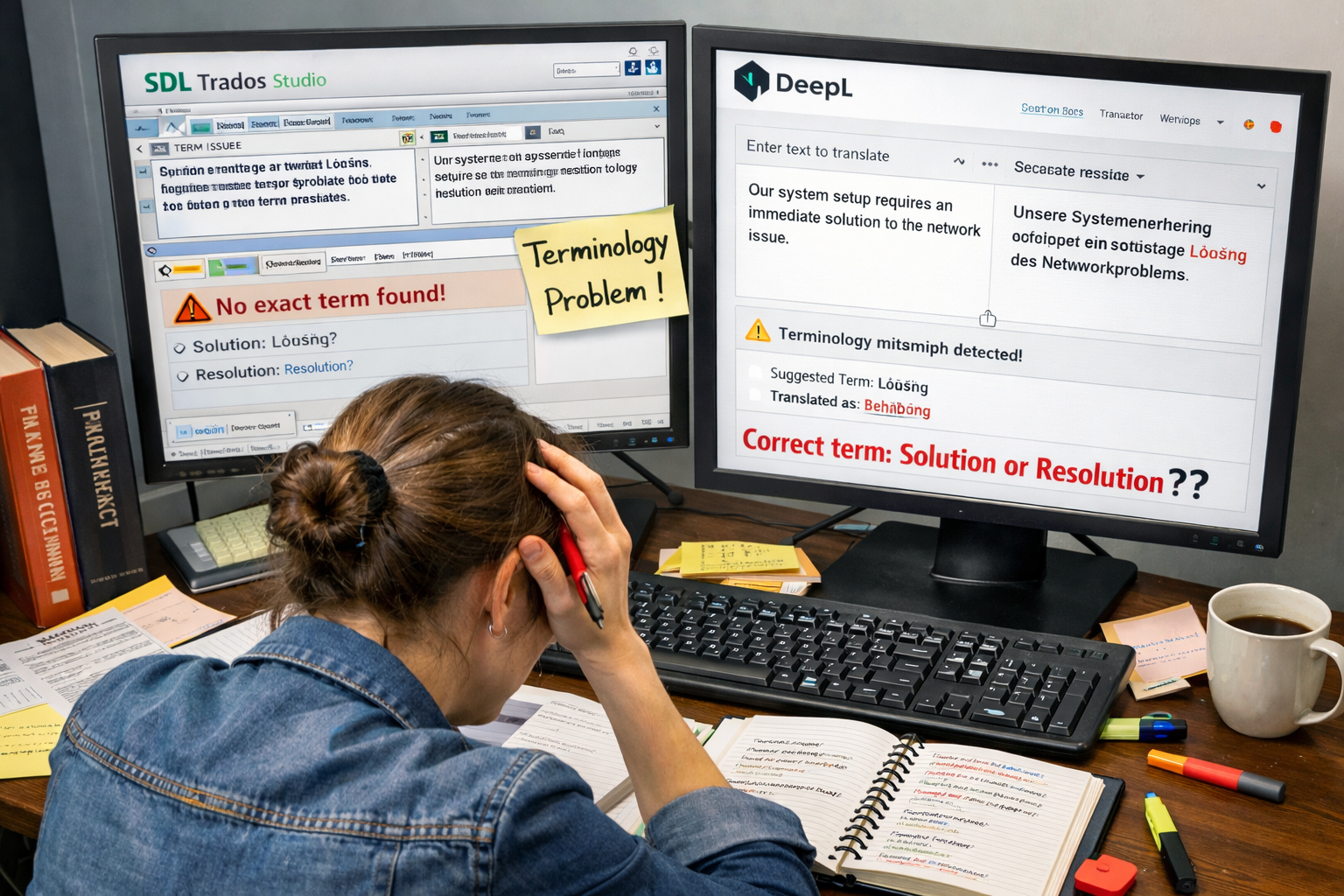
Despite DeepL's impressive quality, terminology consistency represents its most significant weakness in professional translation workflows. DeepL operates as a standalone neural network without direct awareness of client-specific terminology databases or MultiTerm termbases. This fundamental disconnect creates predictable problems.
When translating technical documentation, product materials, or specialized content, consistent terminology is non-negotiable. A product feature must be called exactly the same thing throughout all documentation. Company names, product names, and technical terms require precise, approved translations. DeepL, however sophisticated, lacks access to these organizational knowledge bases and will translate terms based on its training data and contextual interpretation.
This manifests in several problematic ways. DeepL might translate the same source term differently across segments depending on context. It might use synonyms that are technically correct but deviate from approved terminology. It might translate brand names or product identifiers that should remain unchanged. These inconsistencies create additional work for post-editors and quality reviewers, potentially negating some of the efficiency gains MT promises.
The problem intensifies when dealing with terminology that requires specific translations for regulatory, legal, or branding reasons. In regulated industries like pharmaceuticals or medical devices, using unapproved terminology variants can have compliance implications. In marketing and brand communication, terminology consistency directly impacts brand perception and customer experience.
Strategies for Managing Terminology in DeepL-Trados Workflows
Addressing terminology challenges requires deliberate workflow design that combines DeepL's strengths with Trados's terminology management capabilities. The most effective approach involves multiple layers of terminology control and quality assurance.
First, robust pre-translation preparation proves essential. Before engaging DeepL, ensure MultiTerm termbases contain comprehensive, up-to-date terminology for the project. Configure term recognition to highlight approved terms during translation, making deviations from standard terminology immediately visible to post-editors.
Second, implement systematic post-editing protocols that prioritize terminology verification. Post-editors should be trained to recognize common DeepL terminology patterns and know where the engine typically deviates from approved terms. Quality assurance checklists should explicitly include terminology consistency checks, comparing DeepL output against termbases.
Third, leverage Trados's quality assurance features aggressively. Configure QA checks to flag segments where DeepL translations use terms not found in the termbase. Set up verification rules that identify brand names, product identifiers, and critical technical terms, ensuring they receive human review regardless of DeepL's output quality.
Fourth, consider using translation memory strategically to override DeepL suggestions for terminology-heavy segments. When segments contain multiple approved terms, TM matches—even fuzzy ones—might provide better terminology consistency than DeepL's contextual interpretation.
For organizations serious about optimizing their DeepL-Trados workflows, specialized training becomes invaluable. Understanding both the technical integration and the strategic workflow design requires expertise that goes beyond basic CAT tool operation. Platforms like linigu.com offer specialized AI training programs focused specifically on SDL Trados, helping translation professionals master these hybrid workflows and develop the skills to maximize MT benefits while maintaining quality standards.
The Formality and Register Challenge
Beyond terminology, DeepL's handling of register and formality presents another consideration. Many languages distinguish between formal and informal address (T-V distinction), and appropriate register varies by context, audience, and cultural norms. DeepL includes formality settings, but these apply globally to a translation rather than allowing segment-level variation.
Professional translation often requires nuanced register decisions that change throughout a document. Marketing materials might shift from formal to conversational. Technical documentation might use formal language in warnings but casual language in tips. DeepL's single formality setting cannot capture these variations, requiring post-editors to adjust register throughout the translation.
Managing DeepL Output Quality Variation
DeepL quality varies by language pair, content type, and specific linguistic phenomena. While generally excellent for major European languages, it shows predictable weaknesses. Idiomatic expressions sometimes translate too literally. Complex sentence structures might be simplified or restructured in ways that alter emphasis. Domain-specific content receives generic translations when specialized terminology appears.
Effective workflows account for this variation through pre-translation analysis and adaptive quality thresholds. Some projects might achieve ninety percent usable DeepL output requiring light post-editing. Others might see only sixty percent acceptable segments, with substantial revision needed. Understanding these patterns helps set realistic expectations and allocate resources appropriately.
Data Privacy and Confidentiality Considerations
Using DeepL API within Trados introduces data privacy considerations. Content sent to DeepL for translation passes through their servers, raising questions about confidentiality for sensitive materials. DeepL Pro offers enhanced privacy protections and does not use customer data for training, but organizations handling highly confidential content must assess whether any cloud-based MT meets their security requirements.
Some organizations implement policies restricting DeepL to non-confidential content, using human translation exclusively for sensitive materials. Others negotiate enterprise agreements with DeepL that include additional privacy guarantees. The integration of MT must align with broader data governance policies.
Cost-Benefit Analysis and ROI
DeepL integration incurs costs—API usage fees, initial setup time, training investment—that must be weighed against productivity gains. The return on investment depends heavily on content volume, language pairs, and the quality of post-editing processes. High-volume operations translating mainstream content see clear benefits. Low-volume, highly specialized translation might not justify the integration complexity.
Calculating true productivity gains requires measuring not just translation speed but also final quality outcomes. If DeepL reduces initial translation time but increases QA cycles due to terminology inconsistencies, the net benefit diminishes. Comprehensive metrics tracking both efficiency and quality provide the data needed for informed decisions.
Integration with Translation Memory Assets
One consideration often overlooked is how DeepL integration affects translation memory building. Segments translated primarily through DeepL and lightly post-edited enter the TM, potentially carrying subtle quality issues or terminology variations into the institutional knowledge base. Over time, this can degrade TM quality if post-editing is inconsistent.
Best practices involve treating MT-translated segments differently in TM management. Some organizations tag MT-origin segments, allowing later review and potential replacement with fully human translations. Others implement higher quality bars for saving MT segments to TM, requiring thorough post-editing before committing them to long-term memory.
Managing translation assets across different workflows and tools requires careful attention to file formats and compatibility. Organizations working with both MT-accelerated and traditional translation workflows benefit from services that handle conversions between different TM formats, SDLXLIFF files, and standard exchange formats like TMX—capabilities that platforms like linigu.com provide to maintain workflow flexibility.
Best Practices for DeepL-Trados Integration
Successful integration follows several key principles. Start with clear quality expectations and post-editing guidelines that address known DeepL weaknesses. Invest in post-editor training that develops skills specific to refining MT output. Implement robust QA processes that catch the predictable errors MT makes. Use project-level configuration to deploy DeepL strategically rather than universally.
Maintain open communication with clients about MT use, ensuring they understand and approve of MT-assisted translation. Document workflows clearly so all team members understand when and how DeepL should be used. Continuously monitor quality metrics to identify where DeepL adds value and where it creates problems.
Looking Forward
The integration of sophisticated MT engines like DeepL with established CAT tools like Trados represents the current state of professional translation technology. As both systems evolve—DeepL improving its contextual understanding, Trados enhancing its MT integration features—the balance of opportunities and challenges will shift.
The terminology challenge, however, reflects a fundamental architectural issue unlikely to be fully resolved soon. DeepL operates on broad language patterns while professional translation requires specific institutional knowledge. Bridging this gap requires the kinds of hybrid workflows, quality processes, and specialized training that characterize modern professional translation practice.
Understanding both the remarkable capabilities and inherent limitations of DeepL integration in SDL Trados enables translation professionals to harness this powerful combination effectively, achieving the productivity gains MT promises while maintaining the quality and consistency that professional translation demands.