When we talk about the language of artificial intelligence, we're really discussing a fascinating multilayered phenomenon. AI doesn't just use one language—it operates across several linguistic domains simultaneously, each serving a different purpose in the system's functionality. From the low-level code that makes AI possible to the natural language it processes and generates, understanding these linguistic layers provides insight into both the technical architecture of AI and its growing ability to communicate with humans in meaningful ways.
The Foundation: Programming Languages
At the most fundamental level, artificial intelligence systems are built using programming languages. Python has emerged as the dominant language for AI development, favored for its readability, extensive libraries, and strong community support. Libraries like TensorFlow, PyTorch, and scikit-learn provide the building blocks for creating neural networks, training models, and deploying AI applications.
These programming languages serve as the human-readable instructions that tell computers what to do. When an AI developer writes code to create a neural network, they're using a language that bridges human logical thinking and machine execution. The elegance of modern AI frameworks lies in how they abstract complex mathematical operations into intuitive linguistic constructs—functions, classes, and methods that developers can reason about naturally.
Other programming languages also play important roles in the AI ecosystem. R remains popular for statistical analysis and data science. JavaScript enables AI applications to run in web browsers. C++ provides the performance needed for computationally intensive tasks. Java offers cross-platform compatibility for enterprise AI systems. Each language brings its own syntax, semantics, and idioms—its own way of expressing computational ideas.
Machine Language: The True Native Tongue
Beneath the programming languages that humans write lies machine language—the binary code of ones and zeros that processors actually execute. Every Python script, every neural network calculation, ultimately compiles down to these fundamental instructions. This is the AI's true native language, though it's one that humans rarely interact with directly.
Understanding this layer helps explain both the power and limitations of AI. At this level, there's no ambiguity, no context, no meaning in the human sense—just precise electrical signals representing data and operations. The entire sophisticated behavior of an AI system emerges from billions of these simple binary operations occurring at incredible speeds.
The journey from high-level programming languages to machine code involves compilers and interpreters—sophisticated translation systems in their own right. These tools perform their own linguistic transformations, optimizing code and translating abstract concepts into concrete instructions that hardware can execute.
Natural Language: The Interface Layer
Perhaps the most visible aspect of AI language is natural language processing—the ability of AI systems to understand and generate human language. This represents a remarkable achievement: teaching machines to work with the ambiguous, context-dependent, culturally rich communication system that evolved over millennia for human interaction.
Natural language in AI encompasses both understanding and generation. Language models must parse sentences, identify grammatical structures, resolve ambiguities, understand context, and grasp semantic relationships. They need to recognize that "bank" might refer to a financial institution or a river's edge depending on context, that "cool" can describe temperature or approval, and that "I could eat a horse" is probably not literal.
Modern language models process text by converting words into numerical representations called embeddings—vectors in high-dimensional space where semantic relationships are encoded geometrically. Similar words occupy nearby positions in this space, and relationships between words can be represented as mathematical operations. This numerical language allows AI to perform computations on meaning itself.
The generation side is equally complex. AI systems must not only produce grammatically correct sentences but also ensure coherence across longer texts, maintain consistent tone and style, adapt to the context of the conversation, and generate content that's relevant to the prompt or query. This requires mastering the subtle patterns of how ideas connect, how arguments develop, and how language flows naturally.
The Language of Training Data
There's another crucial linguistic dimension to AI: the language of the training data itself. AI systems learn from vast corpora of text drawn from books, websites, conversations, and other sources. The characteristics of this training data—its diversity, quality, biases, and representativeness—fundamentally shape what the AI learns about language and the world.
Training data represents a frozen snapshot of human linguistic behavior and knowledge. It captures not just grammar and vocabulary but also cultural assumptions, historical contexts, common sense reasoning, and domain-specific knowledge. The AI's "understanding" of language is really a statistical model of patterns observed in this training data.
This creates interesting challenges. Idioms, slang, and cultural references in the training data influence how the AI interprets and generates language. Biases present in the training corpus can be reflected in the AI's outputs. Regional variations in language use affect how well the system handles different dialects and vernaculars. The temporal nature of training data means AI systems may be unfamiliar with very recent linguistic developments or cultural shifts.
Specialized AI Languages and Notations
Beyond general-purpose languages, AI has spawned specialized notations and domain-specific languages. Mathematical notation plays a crucial role, as AI relies heavily on linear algebra, calculus, probability theory, and statistics. Researchers and developers communicate about AI using equations that describe model architectures, loss functions, and optimization algorithms.
Query languages allow interaction with AI systems in structured ways. Prompt engineering has developed its own emerging conventions—meta-language patterns that effectively communicate intentions to language models. Techniques like chain-of-thought prompting, role assignment, and few-shot learning represent a new pragmatic language for human-AI interaction.
Markup languages and structured formats like JSON and XML provide ways to represent complex data that AI systems process. Knowledge graphs use formal ontological languages to represent relationships between concepts. These structured representations serve as intermediate languages between unstructured human communication and formal computational processes.
Cross-Linguistic Challenges in AI
AI's relationship with human language becomes even more complex when considering the world's linguistic diversity. Different languages have fundamentally different structures—word order, inflection systems, writing systems, and phonological patterns vary dramatically. Building AI systems that work across languages requires grappling with these deep structural differences.
Some languages are highly inflected, encoding grammatical information within words themselves. Others rely heavily on word order and particles. Some use logographic writing systems where characters represent concepts rather than sounds. These variations mean that techniques effective for English might not transfer directly to other languages.
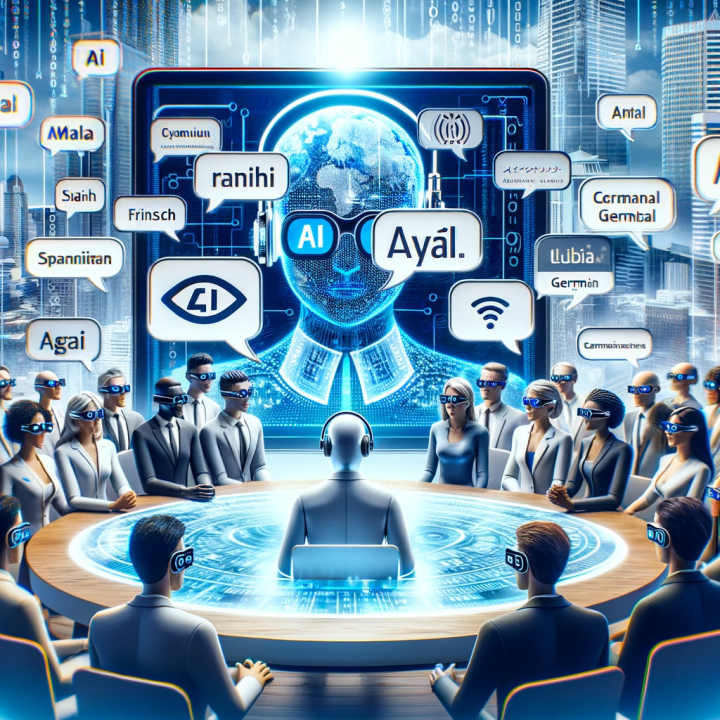
Multilingual AI systems must learn to represent and process these diverse linguistic structures within unified models. Cross-lingual transfer learning attempts to leverage knowledge gained from high-resource languages to help with low-resource ones. However, linguistic diversity remains a significant challenge for truly universal AI language capabilities.
The Evolution of AI Communication
The language of AI continues to evolve rapidly. Early AI systems used rigid, formal command languages that required precise syntax. Modern systems handle increasingly natural, conversational input. The trend is toward AI that can adapt to human communication patterns rather than requiring humans to adapt to machine constraints.
Voice assistants process spoken language with all its disfluencies, false starts, and casual grammar. Conversational AI maintains context across exchanges, handles interruptions, and manages ambiguity gracefully. Multimodal systems integrate language with vision, audio, and other sensory inputs, creating richer channels for communication.
As AI systems become more sophisticated, they're developing new capabilities in pragmatics—understanding not just what words mean but what speakers intend, what's appropriate in different contexts, and how to navigate the social dimensions of language use. This represents movement toward more genuinely intelligent communication.
Future Directions
The future of AI language is likely to see continued convergence between different linguistic layers. Systems that can reason about their own code, explain their decision-making processes in natural language, and learn from linguistic feedback represent emerging frontiers. The boundary between programming and conversing with AI may blur as natural language becomes a viable programming interface.
We may also see AI systems develop their own emergent languages for internal processing or inter-system communication. Early examples already exist where neural networks develop unexpected internal representations that effectively encode information in ways not explicitly designed by humans. Understanding and interpreting these emergent AI languages presents fascinating challenges.
The language of artificial intelligence is remarkably diverse and multifaceted. From binary code to natural language, from mathematical notation to training data patterns, AI operates across numerous linguistic domains simultaneously. As these systems become more central to our technological infrastructure and daily lives, understanding the various languages of AI—and how they relate to human communication—becomes increasingly important for developers, users, and society as a whole.